
The Cut That Never Happened
How our fear of future regret quietly reshapes money decisions

Rakesh bhai ran a tiny tailoring shop near the bus stand; one fan, one stool, one old Singer machine that hummed like a tired bee. The kind of place where regular customers didn’t “order” clothes; they trusted them into his hands.
That afternoon, a family walked in with a neatly folded piece of expensive fabric for a wedding blouse. The mother spoke softly, like she was handing over something fragile. “Bas sambhal ke, bhai. Yehi piece hai.”
Rakesh bhai nodded, seriously. He spread the fabric on the table. Took a piece of chalk. Drew a few faint lines. Measured once. Measured again. Then again. His apprentice, a teenage boy with quick fingers, asked, “Kaat doon?”
Rakesh bhai stopped him with a palm and said, “Nahi. Pehle phir se dekhte hain.” It wasn’t laziness nor it was carelessness. It was fear dressed up as perfection.
He kept imagining the same scene: one wrong cut, the mother’s face falling, the family saying “ab kya?” and walking out with disappointment stitched into the air. He could almost feel the shame in his chest so sharp that his hands went cold.
So he delayed. He re-measured. He adjusted the paper pattern by a millimetre. He looked at the neckline as if it could betray him.
By evening, the family returned and the mother asked for the blouse with hopeful eyes, “Ho gaya?” Rakesh bhai looked down at the fabric. It was still uncut. Still “safe”. He tried to explain, “Main bas perfect kar raha tha…” But the family didn’t come for a philosophy lesson. They came for a blouse.
Without drama, they folded the fabric back, thanked him politely, and left.
Rakesh bhai sat down after they went. The fabric was safe, yes. But the trust was gone. And the loss he was terrified of… happened anyway just in a different shape.
This is a classic example of Loss Forecasting Error.
Not because someone made a “wrong choice”, but because the mind overestimated how unbearable a future loss would feel, and that fear quietly made the real decision.
What is Loss Forecasting Error?
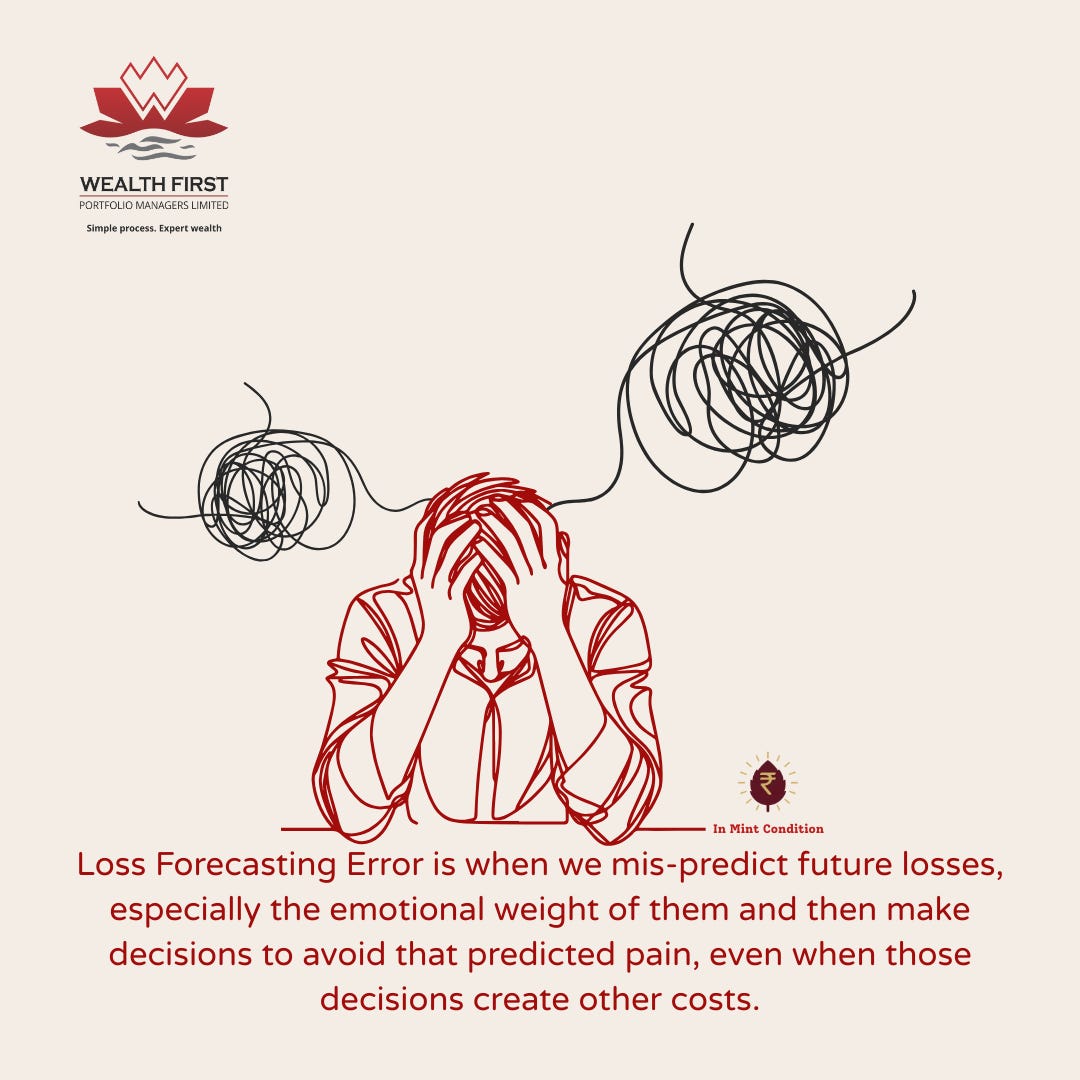
At its core, Loss Forecasting Error is when we mis-predict future losses, especially the emotional weight of them and then make decisions to avoid that predicted pain, even when those decisions create other costs.
Two well-studied ideas sit underneath this:
Impact bias / affective forecasting errors: People often overestimate how intense and how long their negative feelings will last after a bad outcome. Research on affective forecasting documents this tendency to over-predict the emotional “impact” of future events.
Loss aversion (Prospect Theory): Losses tend to feel heavier than equivalent gains, shaping choices in a loss-sensitive way. This “losses loom larger than gains” pattern is central to Prospect Theory.
In other words, we don’t just fear loss, sometimes we mis-forecast it. And that forecast becomes the steering wheel.
How it shows up in financial decisions
When this bias walks into money decisions, it rarely arrives with a label. It looks like:
“I can’t bear seeing this go down even a little.”
So, we shift, stop, exit, or freeze not because the situation objectively demands it, but because the feeling of loss has been pre-lived in our head.
“Let me lock what is working.” + “Let me wait till it comes back.”
This is the famous disposition effect selling what is up (to “book” comfort) and holding what is down (to avoid admitting regret).
“I know exactly what will happen next.”
Overconfidence doesn’t always mean bravado. Sometimes it shows up as over-precision narrow, confident predictions that ignore how wide real-world uncertainty can be.
“Don’t show me the negative angle.”
Confirmation bias makes us search for comfort and dismiss discomfort focusing on supportive information while downplaying conflicting signals.
None of these are “stupid”. They are human. The problem is: they feel protective but can become expensive.
And yes, this is exactly what happened in the story
Rakesh bhai didn’t predict the fabric loss; he predicted the shame loss. He treated that predicted emotion as certain, permanent, and unbearable. So, he chose the one thing that felt safest: no cut.
But in real life, not acting is still an action. It simply hides behind the costume of caution.
Once the mind starts writing a horror story about loss, it doesn’t just change what we do; it changes what we notice, what we ignore, and what we call “sensible”.
The inner mechanics: why we get loss forecasts wrong
1) The “pain will be permanent” illusion
Impact bias makes future discomfort look like it will last forever when, in reality, most people adapt faster than they expect. So, we overpay for emotional safety in the present.
Example: Someone avoids a well-planned long-term commitment because they imagine one bad year will “ruin everything”, ignoring how plans, cashflows, and behaviour can be adjusted.
2) The comfort of a small win vs the shame of a realised loss
The disposition effect is not just about numbers. It is about pride, regret, and closure selling something that’s “working” feels like a win you can hold; accepting something that’s “not working” feels like admitting you were wrong.
Example: People may quickly “book” what feels like progress but keep delaying tough clean-up decisions because they don’t want to face that sinking feeling.
3) Overconfidence, dressed as certainty
Overconfidence has multiple faces overestimating our ability, and over-precision in our predictions. The risk isn’t just being wrong; it’s being confidently narrow in a world that is wide.
Example: A person makes a single “best-case” plan for the year and feels shocked when life behaves like life health events, job changes, and family obligations.
4) Selective attention: we edit out the uncomfortable parts
Confirmation bias can push us to collect only the “good news” that supports our current beliefs and ignores the rest.
That makes loss forecasts worse because the mind is forecasting with incomplete inputs.
The point that matters
Two days later, Rakesh bhai did something small but brave.
He took an old scrap cloth and practised the neckline cut he was afraid of. He drew the line, cut it, and then learned a simple truth: even if a cut goes slightly off, there are ways to recover; stitch techniques, margin buffers, small redesigns.
Next, he wrote a short checklist on the inside of his drawer:
Mark → Recheck → Leave margin → First cut
If unsure: ask apprentice to verify measurement
Start early, not perfect
When the family came back weeks later with a smaller alteration request, he didn’t over-promise. He just said, calmly: “Main kaam shuru karta hoon. Hum step by step karenge.”
That’s the real antidote: replace the dramatic future-loss movie with a process you can repeat. Loss becomes a possibility, not a prophecy.
Key takeaways
Your brain can overestimate future pain. Fear feels like wisdom, but it can be an exaggeration.
Small “relief decisions” can create bigger hidden costs (like exiting early, freezing, or endlessly waiting).
When you feel unusually certain, widen the range. Over-precision is a common trap.
If you’re only consuming information that comforts you, you’re not forecasting you’re soothing.
A repeatable checklist beats a dramatic mood. The goal is not “no loss”; the goal is fewer emotionally driven errors.
Disclaimer: The content shared by Wealth First is for general informational and educational purposes only and should not be considered as investment advice, research, or a solicitation to buy or sell any financial product. Past performance is not indicative of future results. All investments are subject to market risks, including possible loss of principal. Readers should consult their financial, legal, or tax advisors before making any investment decisions tailored to their personal circumstances. While utmost care is taken to ensure accuracy of information and concepts, Wealth First does not guarantee completeness, reliability, or timeliness, and shall not be liable for any direct or indirect loss arising from reliance on such information. All articles contain no offer, inducement, or solicitation for account opening, investment, or trading activity. All characters, events and examples are fictional and used only for illustrative storytelling. Wealth First, its employees, and affiliates expressly disclaim any liability arising from interpretation or use of this material.
References:
Wilson, T. D., & Gilbert, D. T. (2003). Affective forecasting. In M. P. Zanna (Ed.), Advances in experimental social psychology (Vol. 35, pp. 345–411). Academic Press.
Kahneman, D., & Tversky, A. (1979). Prospect theory: An analysis of decision under risk. Econometrica, 47(2), 263–291.
Shefrin, H., & Statman, M. (1985). The disposition to sell winners too early and ride losers too long: Theory and evidence. The Journal of Finance, 40(3), 777–790.
Moore, D. A., & Healy, P. J. (2008). The trouble with overconfidence. Psychological Review, 115(2), 502–517.
Nickerson, R. S. (1998). Confirmation bias: A ubiquitous phenomenon in many guises. Review of General Psychology, 2(2), 175–220.
Campbell, S., & Moore, D. A. (2024). Overprecision in the Survey of Professional Forecasters. Collabra: Psychology, 10(1), Article 92953.
The Decision Lab. (n.d.). Disposition effect. Retrieved February 9, 2026.